

Table of Contents
- Why the Right Tools Make Model Railway Maintenance Easier
- 1. Track Cleaning Rubber: Your First Line of Defence
- 2. Precision Screwdriver Set: For Tiny Screws and Tight Spaces
- 3. Track Cleaning Fluid and Applicator: For Stubborn Grime
- 4. Best Lubricant for Model Train Gears: What to Look For
- 5. Wheel Cleaning Brush: Keeping Locomotives Running Smoothly
- 6. Multimeter: Diagnosing Electrical Faults Before They Worsen
- 7. Rail Joiners and Track Pins: Essential Spares for Quick Repairs
- Frequently Asked Questions
Last Updated: 17 September 2026
Why the Right Tools Make Model Railway Maintenance Easier
The 7 essential maintenance tools for model railway beginners are a track cleaning rubber, precision screwdriver set, track cleaning fluid and applicator, gear lubricant, wheel cleaning brush, multimeter, and spare rail joiners and track pins. Each one solves a specific problem that stops trains running, and buying them together costs far less than replacing a locomotive you damaged through improvisation.
Below, we explain what each tool does, how to use it without damaging delicate parts, and what to look for when buying. The National Model Railroad Association beginner resources are worth bookmarking alongside it.
1. Track Cleaning Rubber: Your First Line of Defence
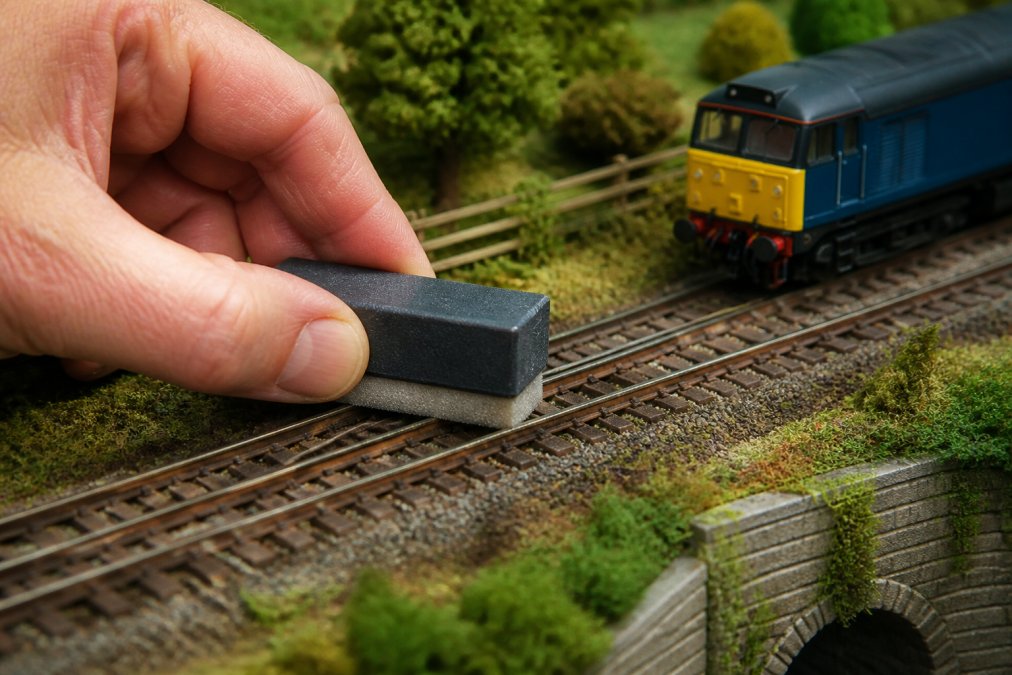
A track cleaning rubber is a mildly abrasive block that lifts oxidised grime and black residue off the railhead. It is the cheapest fix for stuttering locomotives and the tool you will reach for most often.
Hold the rubber flat against the rail top and draw it along the track in one direction, not back and forth. Wipe the loosened residue away with a dry cloth afterwards. Work in short sections of 20 to 30 centimetres so you can see the shine return.
How to Use a Track Cleaning Rubber Without Damaging Rails
Never press hard enough to flatten the rail profile, and avoid rubbing across points and crossing noses where the geometry is delicate. A common mistake is scrubbing until the rail gleams silver; you only need to remove the dark oxidation layer, and over-polishing leaves microscopic scratches that attract dirt faster.
2. Precision Screwdriver Set: For Tiny Screws and Tight Spaces
A precision screwdriver set is a collection of small flathead, Phillips and hex drivers sized for locomotive bodies, bogies and decoder retainers. Most model railway fasteners sit between 1.5mm and 3mm, so a standard household screwdriver will strip the heads.
Buy a set with magnetic tips and a rotating cap so you can hold pressure with one hand. The magnetic tip matters more than the handle: it holds the screw while you guide it into a recessed hole you cannot see.
3. Track Cleaning Fluid and Applicator: For Stubborn Grime
Track cleaning fluid dissolves the oily film that rubber alone cannot shift, particularly in tunnels and under scenery where dust settles. Apply it with a lint-free applicator or cotton bud, never by pouring it directly onto the track.
Isopropyl alcohol is the standard choice for most nickel silver track because it evaporates completely and leaves no residue. Check the label before buying anything marketed as a cleaner, and test it on a hidden section first.
Choosing the Right Cleaning Fluid for Your Layout
Match the fluid to your rail material. Nickel silver handles alcohol-based cleaners well; steel and brass track can react badly to aggressive solvents. Whatever you choose, keep it away from plastic sleepers, painted scenery and ballast, because most solvents will cloud clear plastics and lift acrylic paint.
4. Best Lubricant for Model Train Gears: What to Look For
The best lubricant for model train gears is a plastic-safe, non-gumming grease or oil formulated for small mechanisms. Look for a product labelled safe for plastics and diecast, and avoid general-purpose automotive grease, which thickens over time and attracts dust into the gear train.
Apply a pinhead-sized amount to each gear mesh with a toothpick or syringe. Over-lubricating is the more common error: excess oil migrates onto wheels and track, and you will spend the next month cleaning black residue off your railheads.
5. Wheel Cleaning Brush: Keeping Locomotives Running Smoothly
A wheel cleaning brush removes the conductive grime that builds on locomotive wheel treads and pickup tyres. Dirty wheels cause the same stalling and flickering lights as dirty track, and cleaning only the track solves half the problem.
Fibre-glass pencils and stiff-bristle brushes both work. Use light pressure and rotate the wheel by hand rather than running the motor while you clean. A practical routine is to clean wheels every few running sessions, which is the core of any workable model railway maintenance schedule.
6. Multimeter: Diagnosing Electrical Faults Before They Worsen
A multimeter measures voltage, continuity and resistance across your layout, which turns guesswork into diagnosis. When a section of track goes dead, a multimeter tells you within seconds whether the fault is a loose joiner, a broken feeder wire or a failed point motor.
Set it to continuity and touch the probes to either side of a suspect joiner. No beep means no connection. This one check saves hours of pulling up ballast to find a fault you could have located from above.
7. Rail Joiners and Track Pins: Essential Spares for Quick Repairs
Spare rail joiners and track pins are the consumables of model railway maintenance. Joiners work loose with temperature changes and repeated cleaning, and a single loose joiner can cut power to an entire section.
Keep a small stock of joiners in your track's code and a supply of pins in your baseboard thickness. When you replace a joiner, slide it on with pliers padded with tape so you do not crush the rail web.
| Tool | Job It Does | How Often |
|---|---|---|
| Track cleaning rubber | Removes oxidation from railheads | Every few running sessions |
| Precision screwdriver set | Opens bodies and tightens fasteners | As needed |
| Cleaning fluid and applicator | Dissolves oily film and dust | Monthly, or after long storage |
| Gear lubricant | Protects gear trains from wear | Every few months |
| Wheel cleaning brush | Clears grime from wheel treads | Every few running sessions |
| Multimeter | Traces electrical faults | When a fault appears |
| Rail joiners and track pins | Replaces worn connections | Keep as spares |
Frequently Asked Questions
What tools do I need to start maintaining model trains?
Start with a track cleaning rubber, a precision screwdriver set, and a wheel cleaning brush. These three cover the most common beginner tasks: removing oxidation from rails, tightening loose screws, and clearing debris from locomotive wheels. As your layout grows, add a multimeter for electrical fault-finding and a track cleaning fluid for stubborn grime. A basic set of model railway tools costs very little and prevents most running problems before they start.
How often should I perform maintenance on my model railway layout?
A simple model railway maintenance schedule works well: clean tracks every few running sessions, check locomotive wheels monthly, and inspect wiring and rail joiners every three months. If you run trains daily, clean tracks weekly. In humid conditions, oxidation builds faster, so increase track cleaning frequency. Keep a small notebook or spreadsheet to log when you last cleaned, lubricated, and inspected each section. This prevents guesswork and keeps your layout running reliably.
What is the best way to lubricate model locomotive gears?
Use a plastic-compatible lubricant, applied sparingly with a needle applicator or toothpick. Apply one small drop to each gear contact point, then run the locomotive slowly for a minute to distribute it. Avoid spraying lubricant directly onto gears, as excess attracts dust and causes grinding. The best lubricant for model train gears is one specifically labelled for plastics and metals; general-purpose oils can degrade nylon gears over time. Reapply only when you hear unusual noise or notice sluggish running.
Do I need specialised screwdrivers for model railway repairs?
Yes. Model railway screws are often tiny cross-head or slotted types that standard screwdrivers will strip. A precision screwdriver set with sizes from 1.0 mm to 3.0 mm covers most locomotives, rolling stock, and track fittings. Look for magnetic tips to hold screws in place and ergonomic handles for control. Avoid using a flathead driver on a cross-head screw, as this damages the screw head and makes future removal difficult. A good set lasts years and prevents frustration.
Getting the basics right is what separates a layout that runs reliably from one that sits idle. HobbyTrax supplies the components that keep layouts moving, from specialised tools for model maintenance through to DCC systems and stay-alive capacitors across every gauge. If you are unsure which cleaning fluid, lubricant or spare joiner suits your track, our team can point you to the right part before you buy. Get started with HobbyTrax and keep your rolling stock running the way it should.