

Table of Contents
- How the Hobby Began and Where It Led
- Inside the Red Earth Valley Railway
- Model Railway Maintenance Tools That Earn Their Place
- DC and DCC Model Railway Accessories: Choosing What Suits You
- Model Railway LED Lighting and the Move to HO Scale
- DCC Stay-Alive Modules and the Joys of Reliable Running
- Why We Started HobbyTrax
- Sharing the Hobby With Others
- Frequently Asked Questions
Last Updated: 13 October 2026
How the Hobby Began and Where It Led
More than fifty years of collecting model trains, building layouts and tinkering with railway technology is what led us to start HobbyTrax, an Australian online model railway accessories retailer. That half-century taught us one thing above all: the hobby rewards patience, and it grows with you.
Model railways have a way of staying with people. A layout started in a spare room becomes a lifetime project, and the skills you pick up along the way, wiring, scenery, soldering, tracklaying, keep compounding. What began as a boy with a train set became decades of collecting, experimenting and learning. The technology changed enormously over that time. The pleasure of watching a train run through a landscape you built yourself never did.
For anyone weighing up high precision model railway components for a serious layout, the lessons from those fifty years matter more than any catalogue. Below, we share what the Red Earth Valley Railway has taught us, and why we opened HobbyTrax to pass those lessons on.
Inside the Red Earth Valley Railway
The Red Earth Valley Railway is our own layout, and it includes a coal drop, mines, stations and a logging yard.
Building something that size is a long-term commitment, and it teaches you quickly where the weak points are. Track alignment matters enormously at this scale. So does baseboard rigidity. So does every soldered joint hidden under the scenery.
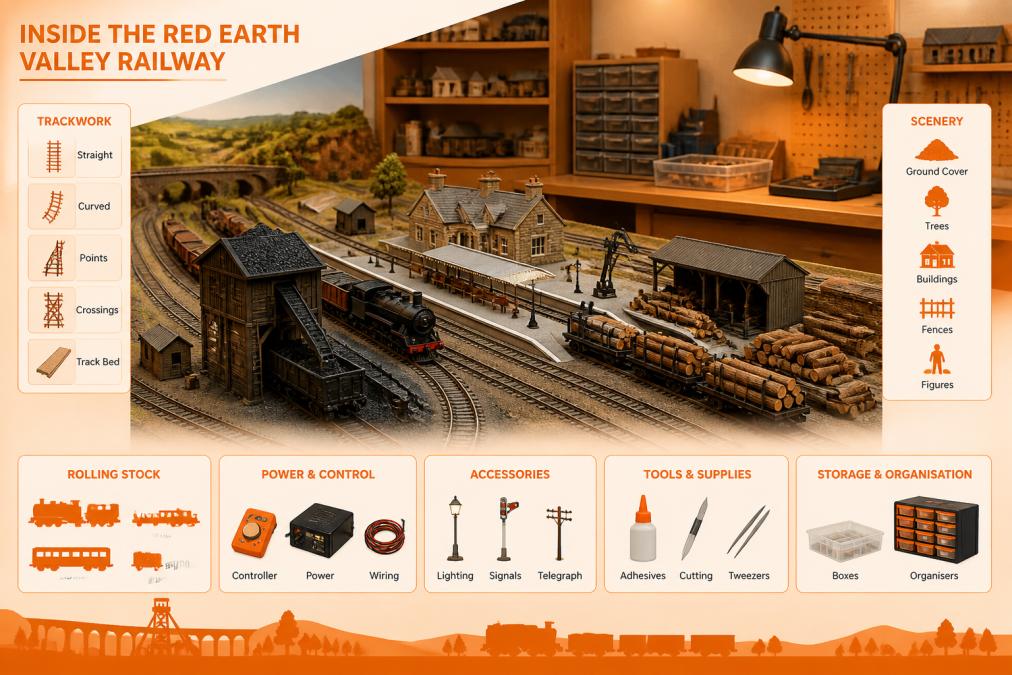
The coal drop and logging yard are the parts we enjoy operating most. They give the railway a purpose beyond watching trains go round, and they justify the shunting moves that make a session interesting.
Model Railway Maintenance Tools That Earn Their Place
Good model railway maintenance tools are the difference between a layout that runs reliably and one that frustrates you. Over the years, a few tools have earned permanent spots on our bench.
Track cutters are near the top of the list. The Trak-Kuts hardened nickel-silver track cutters leave a clean flush cut ready for a rail joiner. They suit most nickel-silver track up to OO/HO gauge. They are not suitable for steel track or point motor pins, and we do not recommend cutting track while it is fixed in place.
Alignment tools matter just as much. The adjustable track spacer and alignment tool holds a consistent centre-to-centre gap between parallel tracks, even around curves. For baseboards that come apart, alignment dowels keep adjoining sections lined up every time you reassemble them.


Tool |
What it solves |
Watch out for |
|---|---|---|
Track cutters |
Clean rail cuts for joiners |
Not for steel track |
Track spacer |
Consistent parallel track gaps |
Set the gap before laying |
Alignment dowels |
Baseboards lining up on reassembly |
Drill a pilot hole before the 8mm hole |
Terminal blocks |
Secure, tidy wiring joints |
Check the current rating suits the job |
DC and DCC Model Railway Accessories: Choosing What Suits You
DC and DCC model railway accessories are not interchangeable, and mixing them up is one of the most common mistakes we see. Analogue DC control sends power straight to the track. DCC sends a digital signal that addresses individual locomotives. A decoder built for DCC will not simply work on a DC layout, and DC accessories are not automatically suitable for a DCC system.
That distinction shapes everything you buy. Before ordering a decoder, a stay-alive or a point motor, check what your controller and your locomotives actually support. Manufacturers differ, and so do models within a single brand.
For testing before installation, the DCC decoder tester checks compatible 6-pin, 8-pin and 21-pin decoders, plus hardwired decoders, outside the locomotive. It works with any type of DCC controller, which means you can confirm motor and lighting functions before committing to a fit.
Model Railway LED Lighting and the Move to HO Scale
Model railway LED lighting transformed how our layouts look, and it arrived at the right time. As eyesight and finger dexterity change with age, many modellers move up a scale. We moved from N to HO for exactly that reason, and it turned out to be one of the best decisions we made.
HO/OO is easier to see, easier to wire and easier to maintain. The detail holds up better under close inspection. If your hands are less steady than they were, a larger scale is not a step backwards. It is a sensible adjustment that keeps the hobby enjoyable.
LEDs suit this scale well, but they are not plug-and-play. Every LED needs a current-limiting resistor, and the correct value depends on your supply voltage and the LED itself. Rather than guessing, work out the value for your circuit, or ask before ordering. We stock 1/4W 1% metal film resistors from 1Ω to 10MΩ in packs of 10, and we are happy to help you pick the right one.

For wiring in tight spaces, 7/0.1mm ultra-thin decoder wire is only 0.6mm in diameter and rated to 0.5A. It is far easier to route inside a locomotive body than standard wire.
1/4W 1% Metal Film Resistors – 1Ω to 10MΩ, Packs of 10 →
DCC Stay-Alive Modules and the Joys of Reliable Running
DCC stay-alive modules are small energy stores that keep a locomotive moving through dirty track, dead frogs and brief power interruptions. On a layout with around 50 points, they are the difference between smooth running and constant stalling.
Reliability is the whole point of this hobby for us. A train that stutters over every crossing ruins the illusion. A stay-alive smooths those gaps, and the effect on a shunting session is immediate.
The same principle applies to weight. A wagon that jumps the points, or a locomotive that struggles on a grade, often just needs a little more mass. 5g self-adhesive metal weights fit inside rolling stock and over the motor for extra traction. They also help dampen the bass rattle in sound-equipped locomotives.
Why We Started HobbyTrax
HobbyTrax grew out of practical experience and a simple frustration. Too often, fellow modellers could not find the small, specific components a layout actually needs. A resistor of the right value. A plug that fits a particular tender socket. A terminal block that suits a control panel.
So we built the shop we wished existed. We stock DC and DCC equipment, electrical components, wire, LEDs, lighting, stay-alives, track, turnouts, scenery, tools, maintenance products, modular bridges, viaducts, platforms, structures and accessories. We also carry a smaller range of pre-owned items for modellers who would rather give a quality model a second life.
Our aim is not to sell you everything. It is to help you find the right thing, and to explain why it suits your layout. You can browse the full range at hobbytrax.com.au.
Sharing the Hobby With Others
Sharing knowledge is the part of this hobby we value most. A beginner intimidated by decoders and wiring should be able to ask a question and get a straight answer, not a lecture. That is the standard we hold ourselves to.
We encourage you to share photographs of your layouts, projects and solutions. Seeing how someone else solved a problem is often more useful than any manual. You can also follow our own modelling on Granddad's Trains on Instagram and the Granddad's Trains Facebook page.
Fifty years in, the pleasure has not faded. Watching a train run through a landscape you built, wired and weathered yourself is still the best part of the hobby. Whether you are just starting or returning after a long break, we are glad to help.
The challenge with a lifelong hobby is keeping it running as your eyesight, hands and spare time change. HobbyTrax exists to make that easier, with high precision model railway components, DCC and DC accessories, stay-alive modules, LED lighting and the practical guidance to fit them correctly. Explore the HobbyTrax range or contact us for compatibility help before you order.
This article was written with the best intentions and reflects personal views. Products and technology change constantly, and while we try our best to provide correct information, specifications and compatibility should always be confirmed with the manufacturer's current documentation.
Frequently Asked Questions
What tools do beginners need to maintain a model railway?
Start with a small set: track cutters for clean rail ends, a track rubber or cleaning block, small screwdrivers, fine tweezers and a multimeter for checking continuity. The Trak-Kuts hardened nickel-silver track cutters handle most rail up to OO/HO gauge, while the 12-way screw terminal block helps keep wiring tidy. Add tools as your layout grows rather than buying everything at once.
How do I choose compatible model railway components?
Check the scale, the control system and the connector type before buying. A DCC decoder tester for 6-pin, 8-pin and 21-pin decoders lets you confirm a decoder works before fitting it. For wiring between a locomotive and tender, the 4-pin pre-wired micro plug and socket is compatible with Hornby X6113 applications. When unsure, check the product listing or contact us for advice.
What is a stay-alive module in DCC model railways?
A stay-alive module stores a small amount of energy so a DCC-fitted locomotive keeps running briefly over dirty track or dead frogs. It reduces stalling and flickering lights without changing how the locomotive is controlled. Stay-alives differ between manufacturers, so check the decoder and locomotive specifications before fitting, and follow the manufacturer's instructions.
Which scale is easier to work with as eyesight and dexterity change?
Many modellers move from N to HO or OO as their eyesight and finger dexterity change. HO/OO models are larger, easier to handle and simpler to wire, which makes maintenance and decoder installation less fiddly. It is a natural progression, not a step down, and the range of accessories in HO/OO is broad.