

Table of Contents
- Brisbane Model Train Show 2026: Dates, Venue and What Happened
- The RMCQ Model Train & Hobby Exhibition: 10-11 October 2026
- Layouts, Scales and Displays You Can Expect
- Traders, Clubs and Demonstrations
- What to Look for at a Model Train Show
- Model Railway Scenery Techniques to Try After the Show
- Tips for First-Time Visitors
- Frequently Asked Questions
Last Updated: September 23, 2026
Brisbane Model Train Show 2026: Dates, Venue and What Happened
The Brisbane Model Train Show 2026 has been and gone, and if you missed it, you missed a genuinely good weekend of model railways. The main event ran Saturday 4 and Sunday 5 July 2026, and by all accounts it delivered what enthusiasts expect: layouts of every scale, traders with hard-to-find parts, and a hall full of people who actually know what a stay-alive capacitor does.
This guide covers what happened, what’s coming next, and how to get more out of any model train show you attend. Everything in this article is written from my own point of view. I have been collecting model trains for more than 50 years, and as my eyesight and fingers have become less steady, I have gradually moved from N to HO scale so I can keep enjoying the hobby. That is a story I will share properly another time.
Confirming Details Before You Travel
Event details change. Venues shift, opening hours get adjusted, and ticket structures are sometimes revised between announcement and show day.
Before you travel to any exhibition, check the organiser's own website or social pages for current opening times, entry arrangements and parking information. We don't publish specific times or prices here because event details can change, and a wrong detail on a blog post is worse than no detail at all.
The practical habit is simple: confirm the day before, not the morning of.
The RMCQ Model Train & Hobby Exhibition: 10-11 October 2026
The next big date on the calendar is the RMCQ Model Train & Hobby Exhibition, running Saturday 10 and Sunday 11 October 2026. If July's show left you wanting more, this is the one to plan around.
RMCQ exhibitions traditionally draw a strong mix of club layouts, trade stands and demonstration tables. It's a show where you can watch a scenic diorama come together in real time, then walk ten metres and buy the scatter material to try it at home.
Check the RMCQ club's official channels closer to October for confirmed venue, hours and admission details. Club-run exhibitions are usually volunteer-organised, so details firm up in the final weeks.
Layouts, Scales and Displays You Can Expect
Scale variety is the real draw at any model train show. You'll typically see HO and OO layouts alongside N gauge, and often larger O gauge or garden-scale displays that need serious floor space.
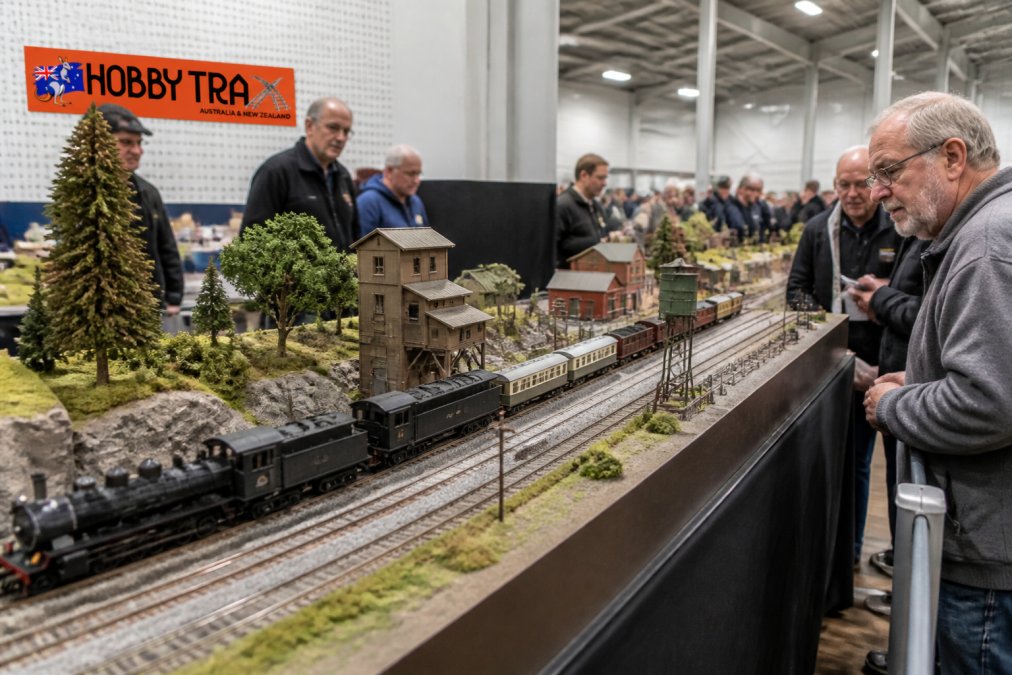
What separates a good exhibition layout from a home setup is operation. Exhibition layouts run to a timetable, with multiple trains moving at once, shunting puzzles in the yard, and signalling that actually works. Watch how operators handle a busy junction, and you'll learn more about layout design in ten minutes than in a week of reading.
Look for:
- - Continuous run layouts with hidden staging yards
- - End-to-end branch line layouts with realistic shunting
- - Dioramas showing scenery techniques up close
- - Children's interactive layouts where kids can drive a train
If you're planning your own layout, photograph the track plans. Most exhibitors are happy for you to photograph the overall design; just ask before taking close-ups of their custom work.
Traders, Clubs and Demonstrations
Trade (private and business) stands at a model train show cover everything from new locomotives to second-hand rolling stock, plus the consumables that are annoying to buy online in small quantities.
Clubs use shows to recruit. If you've been modelling alone, a club stand is where you'll learn about monthly running nights, workshop sessions, and the collective knowledge of members who've been building layouts for decades.
Demonstrations are the underrated part. You'll see ballasting, weathering, tree making and wiring shown step by step. Watch a ballasting demo once, and you'll avoid the glue-soaked mess most beginners create on their first attempt.
What to Look for at a Model Train Show
Go in with a plan and you'll come home with useful purchases instead of impulse buys. Here's what's worth your attention, section by section.
What to Look For |
Why It Matters |
Where to Focus |
|---|---|---|
Locomotives and rolling stock |
Check running quality, not just looks |
Test track if available |
DCC systems and decoders |
Compatibility with your existing fleet |
Ask about decoder types |
Track and turnouts |
Match your existing brand and radius |
Compare rail profiles |
See colours and textures in person |
Scatter, ballast, foliage |
|
Wiring, LEDs, stay-alives |
Ask about resistor values |
|
Precision matters more than price |
Cutters, tweezers, gauges |
|
Value and condition |
Inspect mechanisms closely |
DCC Model Train Installation and Electrical Components
DCC model train installation is the process of fitting a decoder into a locomotive so it can be controlled independently on the same track as other trains. At a show, this is where you learn what actually fits your fleet.

Ask traders which decoder formats suit your locomotives. Hard-wired, 8-pin, 21-pin and Next18 are common, and the wrong choice means a return trip. If you're new to it, our DCC and electrical components range covers decoders, wiring and stay-alive capacitors, and we're happy to talk through what suits your setup.
Stay-alives matter more than most beginners realise. A locomotive with a stay-alive keeps running through dirty track and unpowered frogs, which transforms reliability on pointwork.
Scenery, Track and Pre-Owned Models
Scenery is where layouts either sing or fall flat. Seeing finished scenery in person tells you more about colour and texture than any photograph.
Pre-owned models deserve a proper look. Check the mechanism by rolling the locomotive gently, inspect wheels for wear, and ask whether it's been tested. A well-cared-for second-hand locomotive is often better value than a new one, and giving a quality model a second life keeps good gear running.
HobbyTrax stocks scenery supplies including our own fine scatter material in multiple ground-cover colours, plus structures like the wooden garden shed in N, TT, OO/HO and O gauge and our modular OO/HO platform system.
Model Railway Scenery Techniques to Try After the Show
Model railway scenery techniques are the methods used to build convincing ground cover, terrain and structures, and the best ones are learned by watching someone do them.
Three techniques worth trying after any show:
- Layered ground cover. Start with a base colour, add fine scatter, then build up with coarser material. One flat layer always looks like one flat layer.
- Ballast with care. Apply ballast dry, shape it, then fix with diluted glue. Flooding it straight away washes the profile flat.
- Weather everything. Nothing looks more toy-like than a pristine building. A light wash and some powder make a shed look like it's been standing for years.
Tips for First-Time Visitors
First-timers often arrive overwhelmed and leave having bought the wrong thing. A few habits fix that.
- Bring a list, and bring cash for smaller stands
- Wear comfortable shoes; halls are hard floors
- Take photos of layouts and track plans for reference
- Talk to exhibitors; they're the best resource in the room
- Set a budget before you walk in
Photograph your own layout before and after a show project, and consider sharing them with fellow enthusiasts. We genuinely enjoy seeing what modellers build.
Frequently Asked Questions
When was the Brisbane Model Train Show 2026 held?
The Brisbane Model Train Show 2026 ran on Saturday 4 and Sunday 5 July 2026. As with any event, the 2027 dates and details may change, so confirm with the organiser before you plan your trip. If you missed it, the RMCQ Model Train & Hobby Exhibition on Saturday 10 and Sunday 11 October 2026 is the next major event on the calendar for local enthusiasts.
Where is the show held?
Event venues can change from year to year, so we recommend checking the official organiser website or social pages for the confirmed location before travelling. If you are heading to the RMCQ Model Train & Hobby Exhibition in October, it is held at 20 Terrence Road, Brendale, Brisbane, QLD. Planning your route in advance, including parking (some on-street parking) and public transport options, makes the day far less stressful.
Is the Brisbane Model Train Show suitable for children?
Model train shows are generally family-friendly, with working layouts that children find fascinating to watch. That said, some exhibits are delicate and expensive, so young visitors should be supervised and asked not to touch the models. Check the organiser's information for any child-specific ticketing or family entry options, and consider a shorter visit if little ones tire quickly.
What should I look for at a model train show?
Walk the hall once before buying anything. Look closely at how layouts handle DCC model train installation, wiring and lighting, since these details are hard to judge from photos. Check track, turnouts and scenery supplies, and inspect any pre-owned models carefully for damage, missing parts or running issues. Ask exhibitors about their techniques, and take photos of ideas you want to recreate at home. The RMCQ has an amazing helix to see.
Shows are brilliant for inspiration, but the real work happens at the bench afterwards. Whether you're fitting your first decoder, wiring LEDs into a station building, or ballasting that curve you've been putting off, HobbyTrax stocks the components to get it done. Browse our DCC and electrical range, our scenery and scatter supplies, or our pre-owned models, and if you're unsure what suits your layout, get in touch and we'll point you the right way.