

Table of Contents
- What Is a Model Railway Stay-Alive?
- Why Locomotives Stall or Hesitate
- DC vs DCC Stay-Alive Solutions
- Capacitors vs Purpose-Built Stay-Alive Modules
- What Capacitance Means and Whether Bigger Is Always Better
- Choosing the Correct Stay-Alive
- Installation and Polarity Considerations
- Improving Electrical Pickup on Model Trains
- Frequently Asked Questions
Last Updated: September 26, 2026
What Is a Model Railway Stay-Alive?
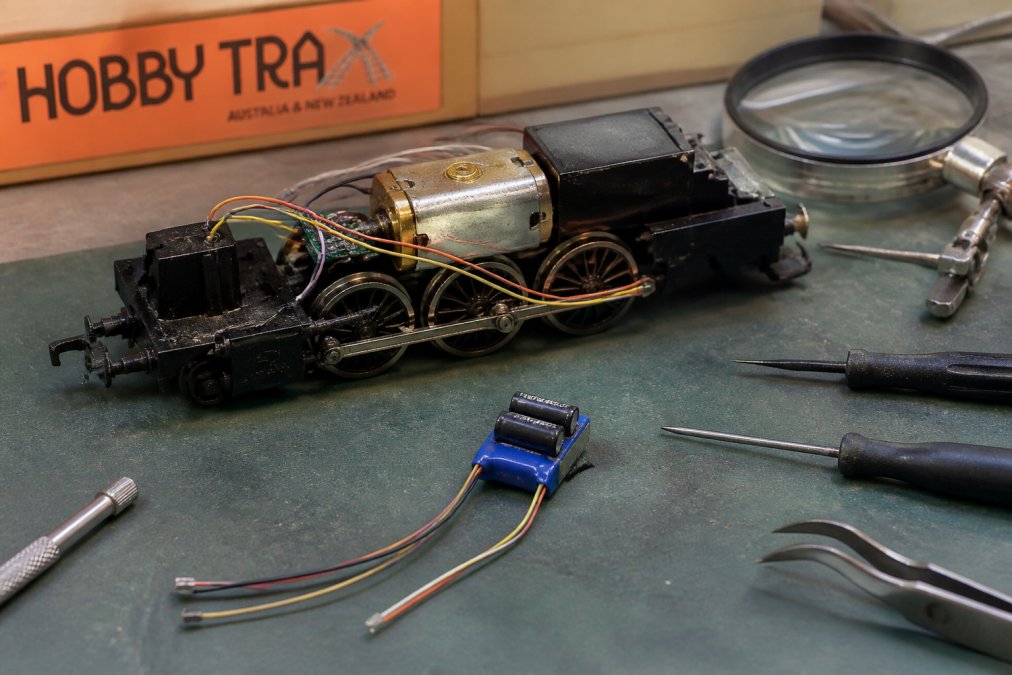
Stay-alive capacitors are small energy storage devices, usually a capacitor or capacitor module, wired into a locomotive so the motor keeps running for a moment when track power is briefly interrupted. If you want to buy stay-alive capacitors online, the first thing to understand is that these devices don't make a locomotive run better overall. They cover gaps. They stop the stutter.
Here at HobbyTrax, we get asked about this constantly, and the honest answer is that a stay-alive is a patch for a specific problem: intermittent electrical contact. It stores energy while the locomotive is drawing power normally, then releases that energy the instant pickup fails. The result is a locomotive that glides over a dirty rail joint, a dead frog or a grain of ballast instead of stuttering to a halt.
Two things are worth knowing before you spend a cent. First, stay-alives are not universal. Voltage rating, capacitance, physical size, polarity and decoder compatibility all matter, and a unit that suits one locomotive may be useless in another. Second, most modern DCC decoders support stay-alives, but the connection method varies by brand. Check your decoder's documentation before ordering. DC units are all hard-wired and, for the most part, universal.
Why Locomotives Stall or Hesitate
Stalling almost always comes down to interrupted current flow, not a faulty motor. A locomotive picks up power through its wheels, and every wheel-to-rail contact is a potential weak point.
The usual culprits:
- Dirty track and oxidised rail. Even a thin film of grime breaks contact.
- Insulated frog points. On many turnouts, the frog is electrically dead, so a short-wheelbase loco can bridge the gap and stop.
- Insufficient pickups. A locomotive with pickups on only one side, or on one bogie, loses power far more easily.
- Worn or bent pickup wipers. They stop pressing firmly against the wheel backs.
- Tight curves and rough track joints. These lift wheels slightly off the rail.
The fix depends on the cause. Clean track and proper pickups solve most of it. Stay-alive capacitors cover what's left.
DC vs DCC Stay-Alive Solutions
Stay-alives work differently depending on your control system, and this is where a lot of confusion starts. In simple terms, a DC stay-alive connects across the motor and works with the analogue controller. A DCC stay-alive connects to the decoder, which manages the energy and feeds the motor and sound.
On DC, the capacitor sits across the motor terminals. When track voltage drops, the capacitor discharges into the motor and keeps it turning. It is a straightforward electrical solution, and it works well with older motors that draw a steady current.
On DCC, the stay-alive connects to the decoder through dedicated terminals. The decoder regulates the discharge so the motor and, on sound-fitted locos, the sound decoder keep running through the gap. Some decoders need a small modification or a specific wire to enable this. Not every decoder supports it out of the box.
Here's what matters most for Australian buyers: HobbyTrax sells DC stay-alives, not DCC stay-alives. Our DC range is designed for analogue locomotives and is supplied in pre-wired and 8-pin plug versions. If you run DCC, check what your decoder supports before ordering anything, because the connection method and voltage handling are different.

Capacitors vs Purpose-Built Stay-Alive Modules
You can build a stay-alive from a bare capacitor and a couple of components, or buy a ready-made module. Both approaches have merit.
A bare capacitor is cheap and small, but you need to add the supporting circuitry yourself: a resistor to limit inrush current, a diode to control discharge direction, and often a voltage regulator so the capacitor doesn't exceed what the motor or decoder can take. Get any of that wrong, and you can damage the decoder.
A purpose-built module arrives ready to install. The protection circuitry is already on board, the leads are attached, and the manufacturer has matched the components for the job. For most hobbyists, this is the sensible choice, especially for a first installation.
Our DC Analogue Stay-Alive Capacitor is a good example. It comes in a pre-wired version for soldering directly across a compatible motor, and an 8-pin plug version for locomotives with a compatible socket. Several capacitor sizes are available so you can pick the largest one that fits.
DC Analogue Stay-Alive Capacitor for →
Option |
Best For |
Effort |
Risk |
|---|---|---|---|
Bare capacitor |
Experienced builders |
High |
Higher if wiring is wrong |
Purpose-built module |
Most hobbyists |
Low |
Low, protection built in |
Pre-wired module |
Older pre-DCC locos |
Low |
Low |
8-pin plug module |
Socket-equipped locos |
Very low |
Low |
What Capacitance Means and Whether Bigger Is Always Better
Capacitance, measured in microfarads, determines how much energy the stay-alive can store. More capacitance means the locomotive keeps running for longer after power is lost.
Bigger is not automatically better, though. Three things limit how large you can go:
- Physical space inside the locomotive. A SuperCap is roughly 18mm wide by 47mm long, which won't fit in a small shunter.
- Motor current draw. A high-current motor drains a capacitor faster, so a large capacitor on an old motor may not help as much as you'd expect.
- Voltage rating. The capacitor's voltage rating must suit your system. Exceeding it will destroy the capacitor, and possibly more.
During our own testing with an older Hornby Ringfield motor, the large capacitor let the motor travel roughly 46% farther after power was removed.
Choosing the Correct Stay-Alive
Match the stay-alive to the locomotive, not the other way around. Work through these questions in order.
- Is the locomotive DC or DCC? This decides everything else. Our range covers DC only.
- Does it have a motor socket? If yes, an 8-pin plug version is the neatest option.
- How much room is inside the body? Measure before ordering. Small, large and SuperCap sizes exist for a reason.
- What does the motor draw? Newer, lower-current motors generally benefit more than older, high-current designs.
- What voltage does the system run at? Confirm the capacitor rating exceeds it.
Installation and Polarity Considerations
Installation is straightforward on paper and fiddly in practice. The wired version is soldered directly across a compatible motor. The 8-pin version plugs into a compatible socket normally used for a DCC decoder.
Before you start:
- Check available internal space, motor type and wiring.
- Confirm polarity. Capacitors are polarised, and reversing them can damage the component.
- Use thin, flexible wire. Our 7/0.1mm ultra-thin decoder wire is 0.6mm in diameter and rated to 0.5A, which suits tight locomotive interiors. It comes in purple, blue, white, grey, orange, yellow, brown and green so you can keep your wiring colour-coded.
- Test the locomotive on a short section of track before closing the body.
Improving Electrical Pickup on Model Trains
A stay-alive is a backup, not a substitute for good pickup. Improving electrical pickup on model trains should always come first, because a locomotive with clean, reliable contact needs less help from a capacitor.

Practical steps:
- Clean rails regularly with a dedicated track rubber.
- Fit additional pickups to wheels that currently have none.
- Check and adjust pickup wipers so they press firmly on the wheel backs.
- Keep wheels clean with a wheel cleaner or a lint-free cloth.
- Check track joints and rail joiners for tightness.
- Consider power-routing or frog switching on turnouts to eliminate dead sections.
Frequently Asked Questions
What does a stay-alive capacitor do for model trains?
A stay-alive capacitor stores electrical energy and releases it when track power is briefly interrupted. That keeps the motor and lights running through dirty track, points, frogs or imperfect wheel contact. In practice, a locomotive fitted with a stay-alive hesitates less, runs more smoothly at slow speed and sounds more continuous. The effect depends on the locomotive, motor current draw, capacitor size and available installation space, so it is worth checking compatibility before buying.
Can I use a stay-alive capacitor on a DC locomotive?
Yes. HobbyTrax sells DC analogue stay-alive capacitors designed for compatible DC locomotives. The pre-wired version has flying leads for soldering across a compatible motor, which suits many older Hornby and Lima models with accessible ringfield or pancake motors. A plug-in version is also available for locomotives with a compatible 8-pin socket. Always check motor type, internal space and wiring before installation, and note that the unit is not compatible with the Hornby R7229 analogue controller.
How do I choose the right capacitance for my model locomotive?
Start by measuring the space inside the locomotive, then choose the largest capacitor that fits safely. HobbyTrax offers small (approximately 10mm x 16mm), large (approximately 13mm x 20mm) and SuperCap (approximately 18mm x 47mm) sizes. Bigger capacitance generally gives a longer stay-alive effect, but newer low-current motors benefit more than older high-current designs. Check voltage rating, physical dimensions and decoder or motor compatibility before ordering.
Are all stay-alive modules compatible with every DCC decoder?
No. Compatibility depends on the decoder, locomotive and installation method. Some decoders have dedicated stay-alive connections, while others need a specific module or wiring approach. Voltage rating, capacitance, polarity and available space all matter. HobbyTrax currently sells DC stay-alives rather than DCC stay-alives, so DCC users should confirm their decoder's requirements first. If you are unsure, speak with an experienced model railway technician.
What are the common mistakes when installing stay-alive capacitors?
Common mistakes include fitting a capacitor that is too large for the body shell, ignoring polarity, soldering to the wrong motor terminal, and assuming every locomotive will respond the same way. Another frequent error is expecting a stay-alive to fix poor track wiring or dirty wheels. Clean track, check pickups and use suitable maintenance tools first. Test fit the capacitor before soldering, keep wiring short and neat, and use thin decoder wire such as 7/0.1mm for tight spaces.