

Table of Contents
- Why Stay-Alive Capacitors Fix Model Train Power Interruptions
- DC and DCC Stay-Alive Systems Compared
- DCC Decoder Stay-Alive Compatibility Before You Buy
- Soldering Stay-Alive Capacitors Safely
- Step-by-Step Installation Checklist
- Testing and Troubleshooting Your Stay-Alive Installation
- When to Ask HobbyTrax or a Technician for Help
- Frequently Asked Questions
Last Updated: 4 October 2026
Why Stay-Alive Capacitors Fix Model Train Power Interruptions
A stay-alive capacitor is a small energy store that keeps a locomotive motor running for a fraction of a second when track power drops out. That brief buffer is often enough to carry a model train across a dirty rail, a dead frog on a turnout, or a momentary loss of contact. If your loco stutters, stalls or stops dead at the same spot every lap, a stay-alive is usually the fix.

A stay-alive will not cure every running fault. It masks short interruptions. It does not fix poor wiring, dirty track or a weak controller. But when the cause really is a brief power break, the difference is dramatic.
Here is the key thing to understand before you buy anything: a DC stay-alive module and a DCC stay-alive are not the same product. Wiring them the wrong way can damage a decoder or a motor. Below, we explain exactly how to install a stay-alive capacitor, how to tell the two systems apart, and when to stop and ask for help.
DC and DCC Stay-Alive Systems Compared
The two systems do different jobs and connect to different points. A DC stay-alive module sits between the track pickups and the motor. A DCC stay-alive connects to a decoder, and only to decoders that support it. Never swap one for the other.
Feature |
DC Stay-Alive Module |
DCC Stay-Alive |
|---|---|---|
Connects to |
Motor circuit, across the motor terminals |
Compatible decoder or its designated stay-alive pads |
Circuitry |
Designed for analogue DC only |
Designed for the specific decoder family |
Supported capacitance |
Set by the module design |
Varies by decoder; check the manual |
Control |
No decoder settings |
May need a CV change where supported |
Best for |
Older DC locos with ringfield or pancake motors |
DCC-fitted locos that stall on points |
Why a DC Stay-Alive Module Is Not a DCC Stay-Alive
A DC stay-alive module is built to work with analogue track voltage and a plain motor. A DCC stay-alive works with the pulsed output of a decoder and often includes extra components to manage inrush current. The two are not interchangeable. A DCC stay-alive wired into a DC loco will not behave as intended, and a DC module wired to a decoder can cause damage.
Sockets, Pads and Hard-Wired Installations
Some locomotives make this easy. Others do not.
- 8-pin socket: A plug-in stay-alive may drop straight in where a decoder socket exists.
- Dedicated pads: Many decoders have marked solder pads for a stay-alive. Use these, not random points.
- Hard-wired: Older locos often need the module soldered across the motor, with no socket at all.
Check your locomotive and decoder before you order. If you are unsure which type you have, send us a photo and we will help you identify it.
DCC Decoder Stay-Alive Compatibility Before You Buy
DCC decoder stay-alive compatibility is the single biggest cause of wasted money in this hobby. Not every decoder supports a stay-alive, and among those that do, the supported capacitance and the connection points vary. Always check the decoder manual first.
Some decoders accept a stay-alive directly on marked pads. Others need a small interface board. A few will not work with one at all. There is no universal answer here, and anyone who tells you otherwise has not read enough manuals.
Voltage Rating, Capacitance and Physical Size
Three numbers decide whether a stay-alive will work and fit:
- Voltage rating: Must suit your system. A capacitor rated below your track voltage is a failure waiting to happen.
- Capacitance: Bigger stores more energy, but takes longer to charge and draws more inrush current.
- Physical size: The real limit. Measure the space inside the body shell before you commit.
Our DC Analogue Stay-Alive Capacitor comes in three sizes so you can match the capacitor to the space you actually have. The small unit is roughly 10mm wide by 16mm long, the large is about 13mm by 20mm, and the SuperCap is around 18mm by 47mm. Fit the largest one that will physically go in.
Soldering Stay-Alive Capacitors Safely
Soldering stay-alive capacitors safely comes down to three things: isolate the power, use the right iron and solder, and keep heat away from plastic. A temperature-controlled iron with a small tip gives you control. Rosin-core solder in 0.8mm diameter flows neatly on small joints.

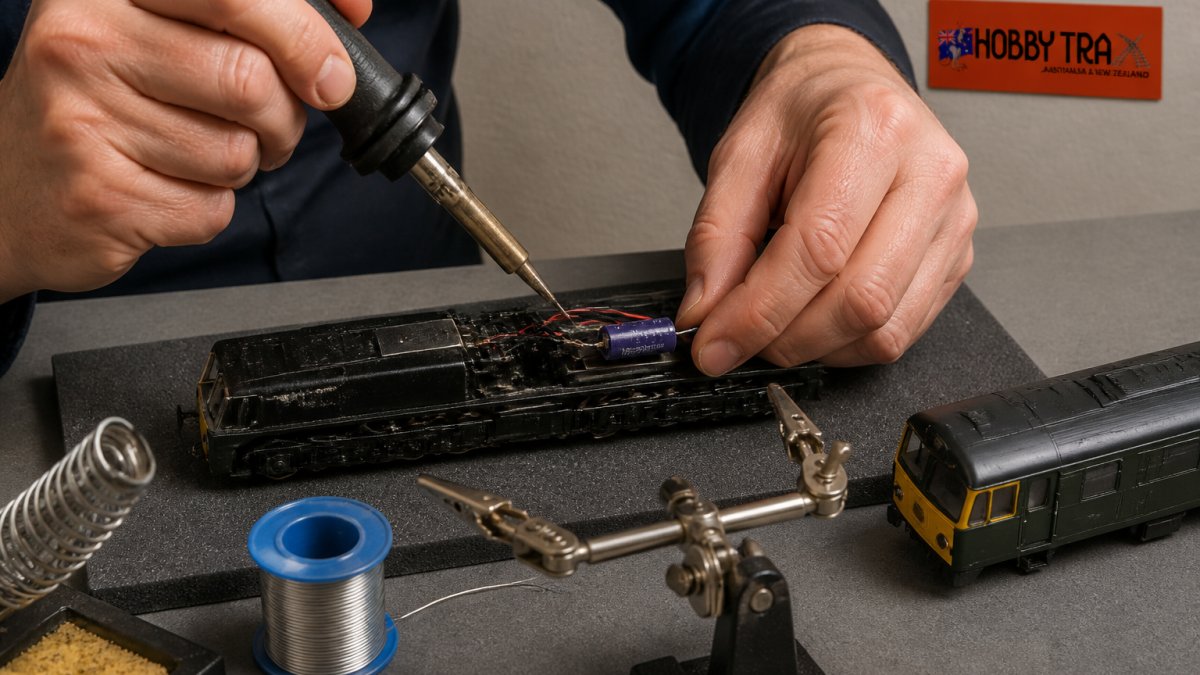
Our Dual-Alloy Rosin-Core Solder Wire Set is a good match for this work. This product contains lead, so use with effective ventilation or local fume extraction and avoid breathing soldering fumes. Wash hands thoroughly after handling. Do not eat, drink or smoke while using the product.
Steps that matter most:
- Disconnect all power. Unplug the controller or command station.
- Test-fit the capacitor before soldering. Confirm it clears the gears and flywheel.
- Keep the capacitor away from heat sources and moving parts.
- Tin the iron tip, heat the joint, then feed solder to the work, not the tip.
- Remove the iron as soon as the solder flows.
- Insulate every joint with heat-shrink.
- Check polarity before you apply power.
Common Mistakes and Warning Signs
Most failures trace back to a handful of avoidable errors.
DC Analogue Stay-Alive Capacitor for Model Railway Locomotives →
- Reversed polarity: The capacitor may vent or fail. Check the markings twice.
- A short: Solder bridging two pads will stop the loco dead and may damage the decoder.
- Heat damage: Nearby plastic sleepers or body shells melt if you linger with the iron.
- Wrong module type: A DC module on a DCC decoder, or the reverse, will not work.
- No insulation: Bare joints touching the chassis cause intermittent shorts.
Step-by-Step Installation Checklist
Work through this list in order. Do not skip the testing steps.
- Identify your locomotive, decoder or controller, and read the manufacturer's diagram.
- Confirm the stay-alive type suits your system, DC or DCC.
- Measure the internal space and choose the capacitor size that fits.
- Test the capacitor with a multimeter before installation.
- Disconnect all track power.
- Mount the capacitor clear of gears, flywheels and heat.
- Solder the connections to the correct points per the diagram.
- Insulate every joint with heat-shrink.
- Reassemble and check for clearance.
- Test on a programming track or current-limited supply first.
- Apply decoder settings only where the manual supports them.
- Run a full lap and watch for stalling or overheating.
If you need components for the job, our Components and Cable and Wire ranges cover the small parts most installs need. Our Tools and Maintenance gear makes the soldering far easier.
Testing and Troubleshooting Your Stay-Alive Installation
Test on a programming track or a current-limited supply first. This limits the damage if something is wrong. If the loco runs normally, the install is sound. If it does not, stop and check before applying full power.
Signs something is wrong:
- Loco runs backwards or not at all: polarity is likely reversed.
- Immediate shutdown: a short circuit. Inspect every joint.
- No stay-alive effect: the module may be the wrong type, or a joint is dry.
- Overheating: wrong voltage rating or a shorted capacitor.
For DCC, only change CVs where the decoder manual says a stay-alive needs it. Many decoders handle this automatically. Do not guess at CV values.
When to Ask HobbyTrax or a Technician for Help
Some installs are genuinely tricky, and there is no shame in asking. If your locomotive is rare, if the decoder manual is unclear, or if you cannot find the correct connection points, get help before you solder.
Our stay-alive fact sheet has diagrams, compatibility guidance and detailed instructions. The Stay-Alives and DCC Systems collections show what we stock. If you are still weighing up control systems, our guide to DCC decoder compatibility tips is worth a read.
Before you order or install anything, contact us with your locomotive and decoder details. Send a photo of the inside of the body shell. We will tell you what will fit, what is compatible and what to avoid.
If you have already completed an install, we would love to see it. Upload a photo of your layout or your soldering work, and help the next modeller learn from your setup.
Stay-alive installs go wrong for one reason more than any other: buying before checking compatibility. Tell us your locomotive and decoder details, and we will confirm exactly which module suits your setup. HobbyTrax offers DC analogue stay-alive capacitors, DCC systems, components, cable and wire and tools and maintenance gear, and our stay-alive fact sheet covers the diagrams and compatibility details. Get in touch with your model details and we will help you get it running smoothly.
Frequently Asked Questions
What is the purpose of a stay-alive capacitor in model trains?
A stay-alive capacitor stores a small amount of energy and releases it when track power is briefly interrupted. That helps a locomotive keep moving across dirty track, dead frogs, points and momentary contact loss instead of stalling. In DC analogue locomotives, a DC stay-alive module is required because the circuitry is designed for analogue control. In DCC, a stay-alive connects to a compatible decoder or its designated points. HobbyTrax testing with an older Hornby ringfield motor showed the large capacitor allowed the motor to travel about 46% farther after power was removed, while the SuperCap produced more than 200% improvement in the same test.
Can I use a DCC stay-alive module on an analogue DC locomotive?
No. DCC and DC stay-alive systems use different circuitry and are not interchangeable. A DCC stay-alive connects to a compatible decoder or dedicated pads, and supported capacitance varies by decoder. A DC stay-alive module must be designed specifically for analogue DC operation. If you fit the wrong type, the module may not work, may cause erratic running, or could damage components. Always confirm your locomotive type and control system first. If you are unsure, contact HobbyTrax with your locomotive and decoder details before ordering.
How do I determine the correct voltage rating for a stay-alive capacitor?
The voltage rating must be at least equal to the maximum voltage the capacitor will see in your setup. In practice, you should check the locomotive, decoder or controller manufacturer's documentation and follow their recommendation. Do not guess. A capacitor with too low a voltage rating can fail or short. Also consider physical size: the HobbyTrax DC stay-alive is available in small (about 10mm x 16mm), large (about 13mm x 20mm) and SuperCap (about 18mm x 47mm) versions, so measure the space inside the body shell before choosing.
What are the signs of incorrect stay-alive wiring?
Common signs include the locomotive running backwards when it should go forwards, the decoder or module getting hot, a short circuit that trips the controller, or the stay-alive having no effect at all. Reversed polarity is a frequent cause. If you see any of these signs, disconnect power immediately and recheck your wiring against the manufacturer's diagram. Never rely on universal colour-to-colour instructions because locomotives, decoders and manufacturers differ. If in doubt, ask an experienced model railway technician to inspect the installation.
Is it safe to install stay-alive capacitors in small locomotives?
It can be safe if you choose a capacitor that fits and does not touch gears, flywheels or heat sources, and if you insulate all joints properly. Small locomotives have limited space, so the small HobbyTrax stay-alive (about 10mm x 16mm) is often the practical choice. Always disconnect power before working, test the module before installation, and use a current-limited supply or programming track for first testing where appropriate. If space or compatibility is uncertain, professional installation is the safer option.