

Last Updated: October 28, 2026
Quick Summary
Warm LED bulbs for model railways sit between 2,000 K and 3,000 K, where lower kelvin numbers look warmer and more yellow. Always fit a series resistor, and plan the lighting before the scenery is fixed.
- Incandescent bulbs waste around 90% of their energy as heat, which LEDs avoid.
- Two products both labelled warm white can differ.
- An LED connected straight to a 12V supply will draw too much current and fail, often within seconds.
- Calculate the resistor as supply voltage minus LED forward voltage, divided by desired current.
Table of Contents
- Why Warm LED Bulbs Beat Cool White on a Model Railway
- LED Colour Temperature for Model Railway: What the Kelvin Numbers Mean
- Warm White LEDs for Model Railway Buildings: Matching the Era and the Scene
- How to Wire LEDs on a Model Railway Without Burning Them Out
- Choosing the Right LED Resistor for Model Railway Lighting
- Mixing Warm and Cool White LEDs Across a Layout
- Planning Your Warm White Lighting Setup
- Frequently Asked Questions
Why Warm LED Bulbs Beat Cool White on a Model Railway
Warm LED bulbs are the difference between a layout that looks like a model and one that looks like a place. Cool white light reads as a hospital corridor. Warm light reads as a gas lamp, a station platform at dusk, a signal box window.
Here is the scale of the problem. Incandescent bulbs waste around 90% of their energy as heat, according to Feit Electric's LED buying guide. LEDs avoid that waste, which is why they now dominate layout lighting. But efficiency is not the point. Colour is.
Warm light pulls the eye in. It makes a row of terraced houses feel lived in. It gives a steam locomotive a glow rather than a glare.
The five mistakes we cover below are worth considering before the ballast is glued down.
LED Colour Temperature for Model Railway: What the Kelvin Numbers Mean
LED colour temperature is a measure of how warm or cool a white light appears, expressed in kelvin (K). Lower numbers look warmer and more yellow; higher numbers look cooler and bluer. For model railways, most period scenes sit comfortably between 2,000 K and 3,000 K.
The range published by Bulbs.com runs from 0-2,900 K for warmer light up to 5,000 K and above for cool white. That is a wide spread, and the difference between 2,700 K and 4,000 K is the difference between a lamplit street and an office block.
A few reference points:
- 2,200-2,700 K: candle and oil lamp warmth, ideal for pre-grouping and Victorian scenes
- 2,700-3,000 K: classic household bulb warmth, good for steam-era stations and cottages
- 3,500-4,000 K: neutral, suits modern depots and industrial yards
- 5,000 K and above: daylight, best kept for workbench task lighting, not scenery
Warm White LEDs for Model Railway Buildings: Matching the Era and the Scene
Period buildings need period light. A Victorian terrace lit with 5,000 K LEDs looks like a film set with the wrong gels in the lamps. Drop to 2,700 K and the same building suddenly has weight and age.
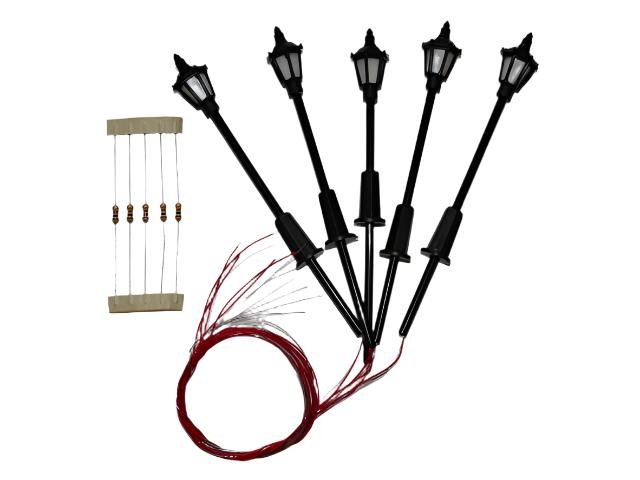
Our Victorian street lights in warm white are 12V DC and come as a five-pack with the correct resistors included.

Match the light to the story you are telling:
- Steam-era stations: warm white, low intensity, few fittings
- Industrial yards: warmer light with a hint of soot, so keep it dim
- Modern depots: neutral white, brighter, more even
- Cottages and shops: warm white, one lamp per window at most
Watch out: over-lighting is the fastest way to kill a night scene. Real period streets were dim. Two lamps doing a job beat six lamps showing off.
How to Wire LEDs on a Model Railway Without Burning Them Out
The single most common cause of dead layout LEDs is skipping the resistor. An LED has almost no internal resistance. Connect it straight to a 12V supply and it will draw far too much current and fail, often within seconds.
A series resistor limits current to the LED. Check the LED and supply specifications to determine a suitable value. Our step-by-step wiring guide walks through the practical method for connecting warm LEDs safely.
Here is a wiring sequence to consider:
- Isolate the power. Never wire with the supply live.
- Check the polarity. LEDs have a positive anode and a negative cathode. Reversing them means no light, and on some LEDs, damage.
- Fit the resistor in series on the positive leg, between the supply and the LED.
- Test on the bench first before fitting into a building or under ballast.
- Insulate bare joints so nothing shorts against track or baseboard.
- Label your feeds so future you knows which circuit is which.
Choosing the Right LED Resistor for Model Railway Lighting
The correct LED resistor for model railway lighting is the value that limits current to the LED's rated level at your supply voltage. You cannot guess it. You calculate it, or you buy LEDs that already have it matched.
The calculation is simple:
(Supply voltage − LED forward voltage) ÷ desired current = resistance in ohms
Then pick the nearest standard resistor value above that figure, and check the wattage rating is adequate. If maths is not your idea of a good evening, buy pre-wired LEDs with matched resistors already fitted.
Our 0.3mm LED kit with wired resistors includes 10 LEDs, 20 cm tails, resistors for 9-13V DC operation and wiring instructions.
Watch out: resistor values are not interchangeable between different LED types. A value that suits one LED can under-drive or over-drive another. Always check the LED's forward voltage and current rating first.
Mixing Warm and Cool White LEDs Across a Layout
A layout lit entirely in warm white can feel flat. A layout lit entirely in cool white feels clinical. The best scenes use both, deliberately.
One approach is to use warm light for inhabited spaces and cooler light for working spaces. Station platforms, cottage windows, shop fronts and street lamps get warm white. Engine sheds, modern depots, signal boxes and yard floodlights can take a cooler tone.
If you use separate circuits, check that the components and wiring are suitable for your setup before installation. Our beginner's guide to DC and DCC wiring explains how to power mixed lighting circuits correctly.
Three practical checks:
- Test the mix on a small scene first. A corner is enough..
- Dim the warm circuit slightly. Warm light at full brightness can read as orange.
Planning Your Warm White Lighting Setup
Plan the lighting before the scenery, not after. Once buildings are glued and ballast is down, every change becomes a repair job.
Start with a simple sketch of the layout. Mark every building, lamp post, platform and yard. Then assign each one a colour temperature and a circuit. You will end up with something like this:
Scene type |
Colour temperature |
Circuit |
Priority |
|---|---|---|---|
Victorian street lamps |
2,200-2,700 K |
Warm A |
High |
Station platform |
2,700-3,000 K |
Warm A |
High |
Cottage windows |
2,700 K |
Warm B |
Medium |
Engine shed |
3,500-4,000 K |
Cool A |
Medium |
Modern yard floodlights |
4,000-5,000 K |
Cool A |
Low |
Then plan the quantities you need. Our LEDs and bulbs collection covers the warm white fittings we stock.
A final thought: decide the mood first, then buy the components to match it.
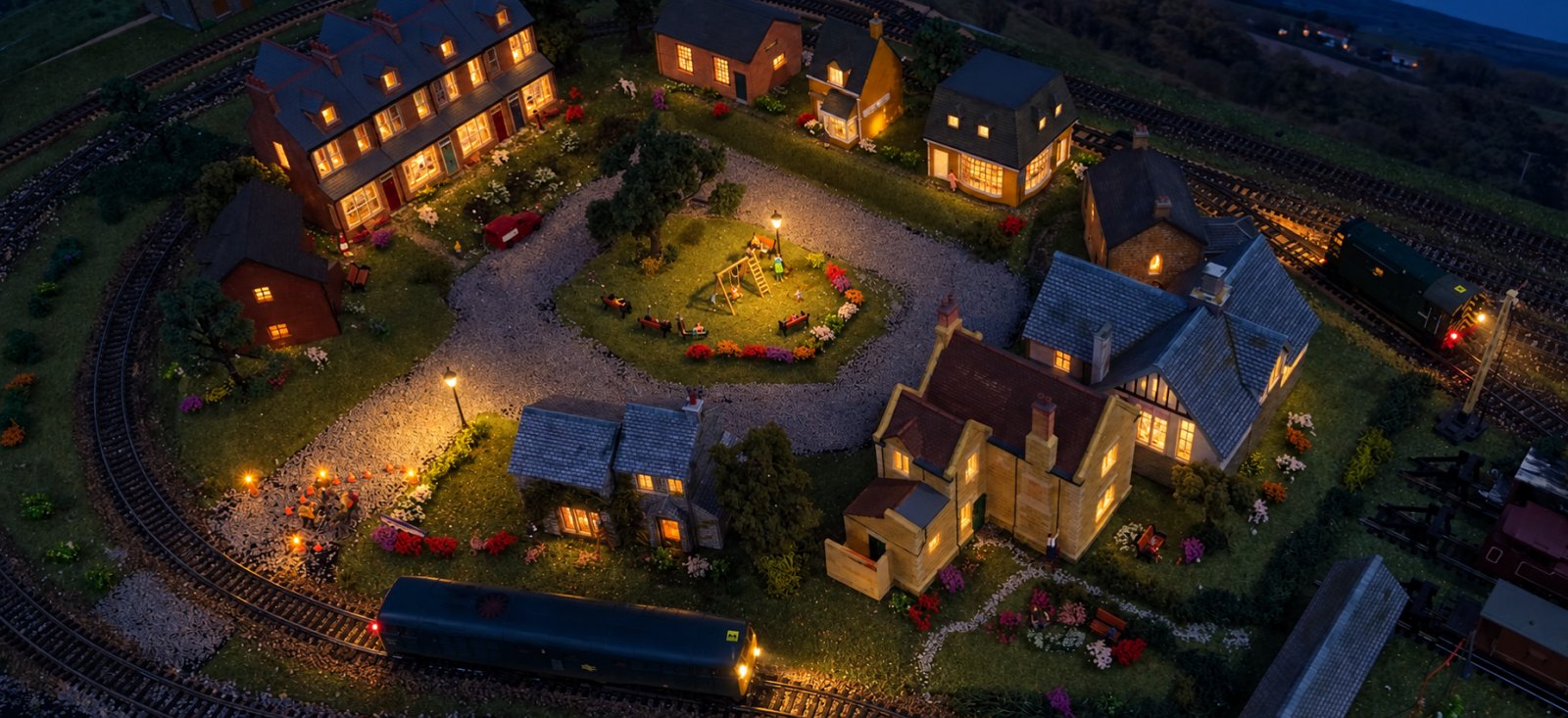
Getting layout lighting right is mostly about avoiding five predictable mistakes: wrong colour temperature, no resistor, over-lighting, mixing circuits carelessly, and planning after the scenery is fixed. HobbyTrax offers lighting products including warm white LEDs, a pre-wired kit with resistors, and Victorian street lights listed for N, HO and O scale. Browse the 0.3mm LED kit with wired resistors before you start.
A note from HobbyTrax: This article reflects our practical modelling experience and information available at the time of writing. Products, specifications and technology can change, so check current manufacturer instructions and compatibility before starting a project.
Frequently Asked Questions
What does warm white mean for LED bulbs?
Warm white describes an LED with a colour temperature below about 3,000 K. The light leans towards yellow and orange rather than the blue-white of cool white.
Do warm LED bulbs need a resistor?
The 0.3mm LED kit includes resistors and 20 cm tails for 9–13V DC operation, according to its listing. Check the product details and your supply specifications before installation.
Can I mix warm and cool white LEDs on a layout?
You can use warm and cool white LEDs on a layout. Check the specifications of each product and plan how the lighting will fit your scene.
How do I choose the right LED for a model railway building?
Check the product's stated scale, voltage and included resistor details against your project and power supply before ordering.
