

Last Updated: November 8, 2026
Quick Summary
Buy model railway parts from an Australian supplier who stocks both DC and DCC components, publishes real specifications and compatibility limits, and answers technical questions before you order. HobbyTrax stocks model railway parts across both systems, and we would rather talk you out of the wrong part than sell it to you.
- A trustworthy listing states scale, electrical ratings, dimensions in millimetres and connector details.
- Track, turnouts, wiring, bus bars, LEDs and scenery work on both DC and DCC layouts.
- Controllers, decoders and stay-alives need system-specific compatibility checks before ordering.
- The Hydra bus bar handles up to 5A and accepts 5-16VDC or DCC supply.
- Confirm scale, system, voltage, current, decoder interface and connector type before adding to basket.
Table of Contents
- What to Look For in an Australian Model Railway Parts Supplier
- DC vs DCC: Which Components Work With Which System
- DC Model Railway Wiring: Planning Power and Distribution
- Model Railway DCC Decoder Compatibility: What to Check Before You Buy
- Model Railway Stay-Alive Installation: Sizing, Fitting and Limits
- Model Railway LED Wiring and Resistors: Getting It Right First Time
- New and Pre-Owned Model Railway Parts: What to Expect
- Your Buyer's Checklist Before Ordering Model Railway Parts
- And what if it doesn’t go!
- Frequently Asked Questions
What to Look For in an Australian Model Railway Parts Supplier
The short answer: buy from a supplier who stocks both DC and DCC components, publishes real compatibility information, and answers technical questions before you order. HobbyTrax stocks model railway parts across both systems, and we would rather talk you out of the wrong part than sell it to you.
A supplier worth ordering from does three things well:
- Lists real specifications. Voltage, current rating, dimensions, connector type and decoder interface on the page, not guessed at.
- Flags compatibility limits. If a stay-alive will not work with a particular controller, that belongs in the listing.
- Answers technical questions. Beginners and returning modellers both need someone who can say "check the pin count before you order".
What good product information actually looks like
Vague listings are the main cause of wrong orders. A listing you can trust usually includes:
- Scale and gauge, stated explicitly rather than implied by the product name.
- Electrical ratings, voltage range, maximum current, and whether the item is DC-only, DCC-only or suitable for both.
- Physical dimensions in millimetres, so you can check it against the space inside a locomotive body or under a baseboard.
If a listing is missing two or more of those, ask before ordering.
Match the supplier to your project, not the other way round
- Starting out in analogue DC. You need track, turnouts, section wiring, a controller and basic tools. Prioritise a supplier who stocks plain DC accessories and explains section wiring.
- Upgrading a DC layout. You need point motors, switches, bus wiring and lighting. Look for clear current ratings and distribution boards.
- Building a DCC layout. You need a command station, decoders, stay-alives and decoder wire. Look for socket and interface detail on every decoder listing.
Support, documentation and after-sales
A supplier's value shows up after the sale as much as before it. Worth checking:
- Fact sheets and technical articles that explain installation, not just sell the part.
- A way to ask a compatibility question before you commit.
- Clear returns information so you know where you stand if a part does not fit.
When looking for model train shops in Australia, the practical test is simple: does the product page tell you enough to check it against your own layout? For a deeper look at decoder interfaces, our guide to DCC decoder compatibility covers the checks in detail.
DC vs DCC: Which Components Work With Which System
DC (direct current) and DCC (Digital Command Control) both deliver power to the track, but they control locomotives in completely different ways. DC varies track voltage to change speed and uses reversing polarity for direction. DCC puts full voltage on the track constantly and sends digital commands to a decoder inside each locomotive.
That difference decides which parts you can share between systems.
Parts that work with both DC and DCC
- Track and turnouts. The rail itself does not care what feeds it. Insulfrog and electrofrog turnouts work on both, though wiring practice differs.
- Wiring, bus bars and droppers. Copper is copper. Our Hydra 16-Channel DC/DCC Bus Bar with Isolation is built for exactly this, with a 5A maximum per board, a recommended supply of 5-16VDC or DCC, and red and green LEDs showing polarity or DCC signal presence.
- LEDs and lighting. Layout lighting runs off its own supply on either system.
Parts that need system-specific compatibility checks
- Controllers and power supplies. An analogue controller and a DCC command station are not interchangeable.
- DCC decoders. Only relevant to DCC, and only to locomotives with a compatible socket or enough space for a hard-wired install.
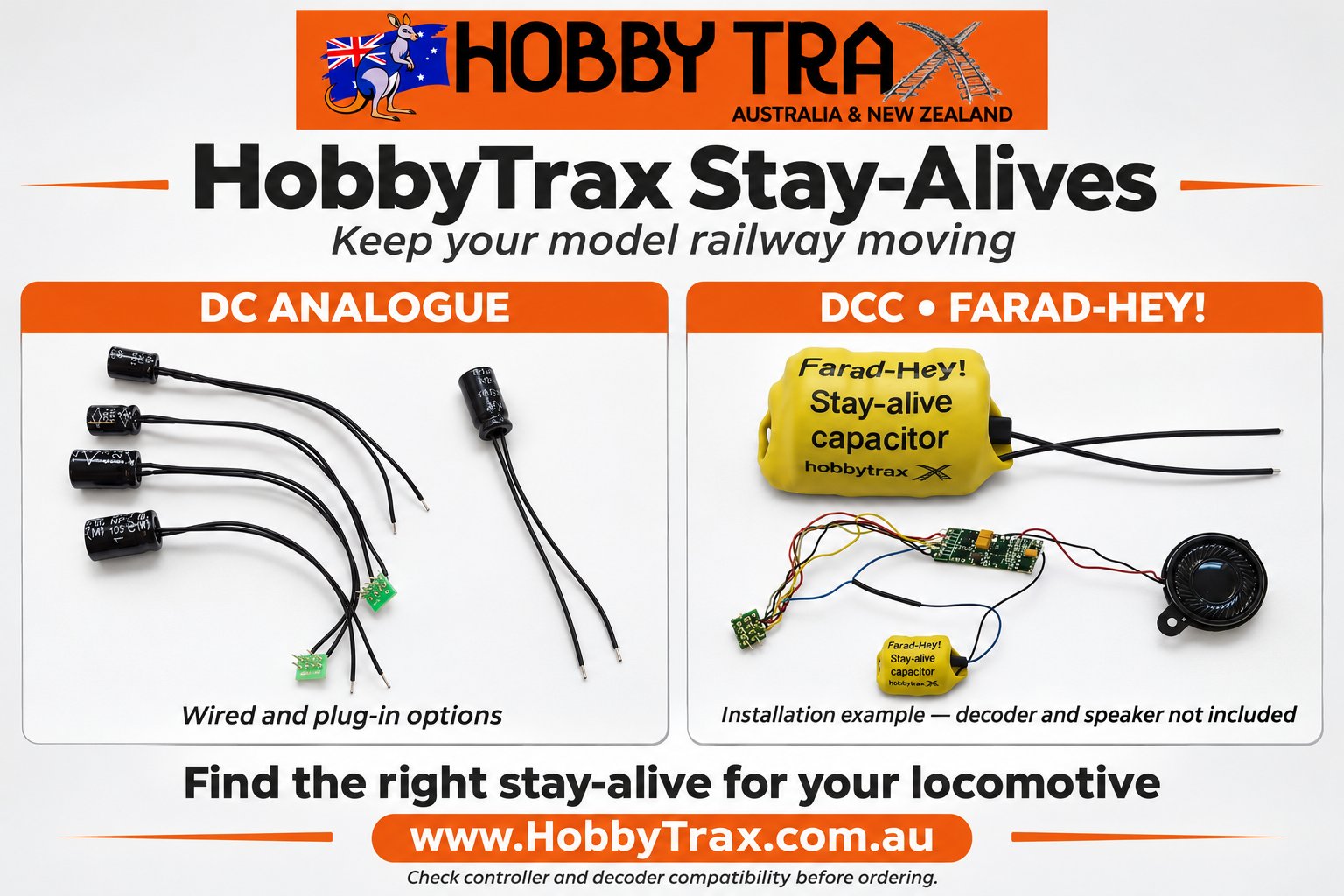
- Stay-alives. Ours are DC analogue units, and the listing states clearly that they are not compatible with the Hornby R7229 analogue controller.
Watch out: assuming a plug fits because it looks similar. An 8-pin socket and an 8-pin plug still need the correct orientation and pin alignment confirmed.

Component |
Works with DC |
Works with DCC |
Check before buying |
|---|---|---|---|
Track and turnouts |
Yes |
Yes |
Turnout wiring method |
Bus bars and wiring |
Yes |
Yes |
Current rating |
LEDs and lighting |
Yes |
Yes |
Resistor value, supply voltage |
Controllers |
Yes |
No |
System type |
Decoders |
No (some |
Yes |
Socket type, space |
Stay-alives |
Yes |
Model-specific - Mostly yes |
Controller compatibility |
DC Model Railway Wiring: Planning Power and Distribution
Plan your DC wiring around sections first, then buy parts to match.
The mistake most beginners make is wiring everything back to the controller terminals in a tangle. A distribution board fixes that.
Three things to confirm before you order:
- Current draw. The Hydra board handles up to 5A. Add up your locomotives and accessories.
- Supply voltage. The board accepts 5-16VDC or DCC.
- Board size. At 40 x 125mm, check it fits your under-layout space.
Use consistent wire colours for track feeds and keep droppers short. Solder neatly, insulate every joint, and test each section with the power off before you run anything.
Model Railway DCC Decoder Compatibility: What to Check Before You Buy
Decoder compatibility comes down to four things: the socket, the current rating, the physical space, and the motor type.
Start by identifying your locomotive’s decoder socket, such as 8-pin, 21-pin or Next18, and choose a decoder with the matching interface. If there is no socket, you may need a hard-wired installation. Check the decoder’s dimensions and motor current rating before buying.
Our 7/0.1mm ultra-thin decoder wire is 0.6mm overall diameter with a 0.5A maximum current, which suits decoder installs where space is tight.

Then check current. A decoder rated below your locomotive's stall current will fail. Measure it or look it up rather than guessing.
One extra layer of protection worth knowing about is the DCC Decoder Saver.

Model Railway Stay-Alive Installation: Sizing, Fitting and Limits
A stay-alive capacitor stores energy and briefly supports the motor when dirty track, points or a momentary contact loss interrupts power.
Our DC analogue stay-alive comes in three sizes:
- Small: approximately 10mm wide x 16mm long
- Large: approximately 13mm wide x 20mm long
- SuperCap: approximately 18mm wide x 47mm long
Two connection options exist. The pre-wired version has flying leads for soldering across a compatible motor, which suits many older pre-DCC Hornby and Lima locomotives with accessible ringfield and pancake motors. The 8-pin plug version fits a compatible 8-pin socket normally used for a DCC decoder.
Where it falls short: older high-current motors may only see limited benefit. Newer, lower-current motors respond better.
If you are fitting one to an analogue locomotive for the first time, our step-by-step guide to installing stay-alive capacitors in DC model trains walks through the process.
Model Railway LED Wiring and Resistors: Getting It Right First Time
Every LED needs a resistor, and getting the value wrong is the quickest way to destroy one. Work out the resistor from your supply voltage, the LED's forward voltage and its rated current, then check your maths before soldering. Our pre-wired LEDs have resisters built in.
A few habits prevent most failures:
- Never connect an LED straight to a supply without a resistor in series.
- Check polarity. LEDs are directional, and reversing them can damage the component.
- Test on a breadboard or with a temporary connection before fitting permanently.
For layout lighting specifically, our walkthrough on wiring model railway streetlights covers resistor selection and power supply setup in practical detail. Insulate every joint, keep wires clear of moving parts, and switch the power off before you touch anything.
New and Pre-Owned Model Railway Parts: What to Expect
New parts come with manufacturer documentation, current specifications and a known history. Pre-owned parts offer something different: quality equipment given a second life, often at a lower cost, with condition described individually.
Reading a pre-owned listing properly
A pre-owned listing should tell you four things before you commit:
- What the item is, manufacturer, model, scale and any variant detail such as livery or running number.
- Its condition, cosmetic and mechanical described separately where possible.
- What has been checked, and, just as importantly, what has not.
If a listing is silent on condition or testing, ask. Treat an unstated claim as unverified rather than assuming the best.
Condition vocabulary worth knowing
Sellers use condition terms loosely, so check what they mean in context:
- New old stock, unused but old; packaging may be shelf-worn and lubricants may have dried out.
- Excellent, runs well, minor cosmetic marks, no missing parts.
- Good, runs, but may show wear, fading or a missing detail part.
A worn pinion gear will ruin running quality no matter how good the decoder is, so mechanical condition matters more than box condition for anything you intend to run.
Spare parts and older locomotives
For older locomotives, spare parts matter as much as electronics. The Hornby X8271 11-tooth pinion gear suits compatible 3-pole Ringfield motors, and the listing warns clearly not to confuse it with the 10-tooth X9061 used in some 5-pole applications.
Watch out: assuming a part fits because the locomotive looks similar. Ringfield motor versions vary, so tooth counts are not interchangeable.
Why pre-owned is worth considering
Quality equipment given a second life keeps usable models running instead of sitting in a drawer. For a beginner, a well-described pre-owned locomotive can be a sensible way to learn before committing to new stock.
Pre-owned items are listed with their condition and what has been checked. Availability varies because each item is usually a one-off, so ask about condition before ordering if it matters to your project.
Your Buyer's Checklist Before Ordering Model Railway Parts
Run through this list before you add anything to a basket. It takes two minutes and saves returns.
- Scale and gauge confirmed. HO and OO share track but not body dimensions.
- System confirmed. DC analogue or DCC, and which controller you are running.
- Voltage and current checked against the product's rated limits.
Two worked examples show how this plays out.
Example one, DC wiring. You are wiring a DC layout with three isolated sections and two locomotives. You need a distribution board rated above your combined current draw, wire for droppers, and a switching method for each section. The Hydra board at 5A maximum and 5-16VDC supply covers the distribution, and its isolate function gives you a fast way to shut off a section when a short appears.
Example two, DCC decoder or stay-alive. You have a DCC-ready locomotive with an 8-pin socket and limited internal space. Choose an 8-pin decoder with a suitable motor current rating, then check that the decoder and its wiring fit beneath the body. If you also want a stay-alive, confirm that the decoder supports one and follow its manufacturer’s connection instructions. An 8-pin socket alone does not confirm stay-alive compatibility. Choose a unit designed for your DCC decoder—our DC analogue stay-alives are a different product. If you are unsure, send HobbyTrax your locomotive model and decoder details before ordering.
And what if it doesn’t go!
At HobbyTrax Australia, we welcome enquiries about electrical repairs, fault diagnosis, servicing and selected DCC upgrades for OO and HO gauge model railway locomotives and equipment. We assess Hornby and other manufacturers, subject to workshop capability, model condition and spare parts availability.
Repairs and servicing
We will review most locos; Hornby locomotives are a key focus of our workshop, including older models with running, pickup, motor, drivetrain or wiring problems. Send us your enquiry, and we will advise you of the assessment process. Call us on (07) 3566 1476 or send us a Repair Assessment Request.
Sorting DC from DCC is the part that trips up most modellers.
A note from HobbyTrax: This article reflects our practical modelling experience and information available at the time of writing.
Frequently Asked Questions
Can the same model railway track be used for DC and DCC?
Yes. Standard track and turnouts carry either an analogue DC supply or a DCC signal, so the rails themselves do not need changing when you switch systems. What changes is the control equipment feeding the track and the locomotives, which need DCC decoders fitted. Check that turnouts and any accessory wiring suit your chosen system, and keep joints clean and tight, because both DC and DCC depend on reliable rail contact.
How do I choose a DCC decoder for my locomotive?
Start with the locomotive's socket or wiring arrangement, such as an 8-pin socket or a hard-wired installation, then confirm the decoder's current rating suits the motor. Check the manufacturer's instructions for the specific model, and allow space for the decoder and any protection adapter inside the body. If the locomotive is DCC-ready, match the plug type exactly. When unsure, ask before ordering rather than guessing, because a decoder that does not fit or suit the motor is money wasted.
What should I check before buying a model railway stay-alive?
Confirm whether your locomotive is DC analogue or DCC, because the two need different stay-alive arrangements. Check the available internal space against the capacitor dimensions, and note the controller compatibility stated by the supplier. For DC analogue use, our stay-alive listing notes it is not compatible with the Hornby R7229 analogue controller. Older high-current motors may gain only limited benefit. Fit the largest capacitor that fits, and test before closing the body.
How do I choose wiring and power distribution parts for a model railway?
Work out how many track sections and accessories you need to feed, then choose a distribution board with enough terminals and a current rating above your expected load. Our Hydra bus bar offers 16 output terminals and a maximum of 5A per board, with an isolate function that helps trace shorts. Use wire rated for the current it carries, keep droppers short and tidy, and label connections. Test each section before permanent fitting.
